Share this
Key Takeaways
- FCFS dock scheduling has no appointments: the first truck in line gets served first
- It creates congestion, unpredictable staffing, and expensive detention fees
- A 5-truck FCFS example generates $390 in detention costs in a single morning
- Appointment scheduling eliminates that cost and Opendock makes switching straightforward
Most operations managers are familiar with "first come, first serve" (FCFS) and in dock scheduling, it means exactly what it sounds like. The first truck in line gets unloaded first, the second waits for the first, and so on down the queue. No appointments. No pre-planning. No visibility into what's coming or when.
Opendock works with warehouses every day that are still running FCFS scheduling and the teams running them often know it isn't working. The hard part isn't understanding the problem. It's making the change.
What Is FCFS Dock Scheduling?
FCFS (first come, first serve) dock scheduling means no appointment is required for carriers to arrive. Trucks show up when they choose — or when they can — and receive a dock door in the order they arrive. The system requires almost no setup, which is the main reason it became the default at so many facilities.
FCFS scheduling is simple to communicate to carrier partners and demands minimal resource planning from the warehouse. Carriers understand it intuitively because it has been standard practice for decades. That familiarity creates inertia. Even when the operation is struggling, teams default to "it's always been this way."
What FCFS scheduling can't account for is congestion. When a line forms — whether it's five carriers arriving at Monday 8 AM after a weekend closure or a surge before a holiday, 53-foot trailers wrap around the building, block access, and compress your entire day's operation into a reactive scramble.
Why Does FCFS Scheduling Make Warehouses Less Efficient?
The short answer: FCFS scheduling rewards the willingness to wait, not operational efficiency. A carrier willing to arrive two hours early and idle in your lot gets served before one who timed their arrival to what should have been a reasonable window. There is no incentive alignment for anyone.
Beyond the line itself, FCFS creates a cascade of downstream problems for warehouse operations:
- Unpredictable labor needs. Without knowing when trucks will arrive, warehouse managers cannot accurately schedule staff. Teams either overstaffed for volume that never comes or scrambling during an unexpected surge.
- Dock door congestion. Trucks queuing in your yard create safety hazards, block access for other vehicles, and create friction with neighboring facilities or public roads.
- No data for planning. Without appointment records, there is no baseline to improve against. Combining dock scheduling with a yard management system gives operations teams the visibility to turn scheduling data into real operational improvements.
- Overtime and detention fees. A surge of trucks arriving near shift end generates overtime costs at the warehouse and detention fees for the carrier — costs that compound quickly.
GPS tracking and predictive ETA tools have improved carrier visibility, but they don't solve the core problem. These tools tell you a truck is 45 minutes away — they don't tell you whether a dock door will be available, whether your crew is staffed to unload, or whether three other trucks are already in your yard. Appointment scheduling closes that gap.
What Does FCFS Scheduling Really Cost Your Warehouse?
The detention fees are the easiest number to quantify, but they're not the only cost. Here's a concrete example of what FCFS looks like on an average Monday morning.
Consider a warehouse with the following operating parameters:
- Hours of operation: 8 AM to 1 PM
- One dock door active
- One-hour unload duration per truck
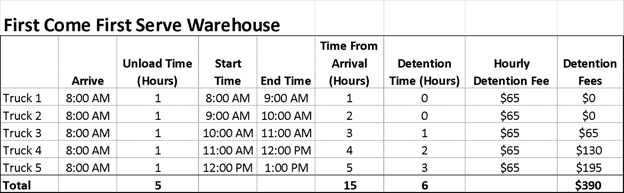
For example, five trucks arrive at 8 AM after a weekend closure. In an FCFS operation, the fifth truck waits five hours before being touched. Using the national average detention rate of $65/hour, trucks three, four, and five each incur detention time, generating $390 in detention costs in a single morning from five trucks.
That number doesn't include:
- Overtime for warehouse staff playing catch-up
- Staff idle time earlier in the day waiting for trucks that arrived late
- Morale impact of teams that routinely start behind and can never get ahead
- Carrier relationships damaged by consistently poor dwell times
In a warehouse without appointment scheduling, trucks arrive inconsistently throughout the day. Unplanned arrivals mean unprepared staff and paying people to wait when nothing is coming, then paying overtime when everything arrives at once. Those inefficiencies compound with each carrier that loses hours of service to your dock queue.
If you're not sure whether these costs apply to your operation, this dock scheduling checklist walks through the signals that indicate appointment scheduling would pay for itself quickly.
What Does Appointment Scheduling Actually Look Like?
Appointment scheduling means carriers receive a specific arrival window based on your dock door availability, labor capacity, and operating hours. Instead of five trucks arriving at 8 AM, appointments are staggered, one per hour, matching each arrival to a ready dock and a staffed crew.
Using the same five-truck example: with appointments staggered one hour apart, the warehouse incurs zero detention fees if trucks arrive as scheduled. That's a $390 savings for a single morning and appointment scheduling compounds those savings across every operating day.
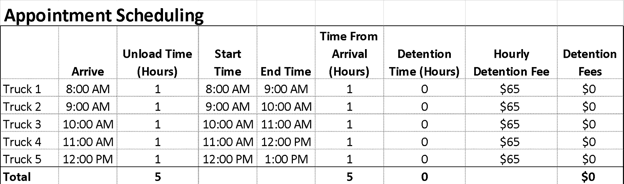
From the carrier side, the benefit is equally clear. In the FCFS scenario, carriers collectively waited 15 hours across those five trucks. With appointments, total carrier wait time drops to 5 hours. Carriers arrive knowing when they'll be unloaded, which protects their hours of service, reduces detention disputes, and makes your facility a preferred destination over competitors still running FCFS.
Opendock has found that when trucks have a scheduled appointment time, on-time arrival rates improve substantially, even accounting for factors outside a carrier's control like traffic and weather. A specific time target changes driver behavior. The certainty of an appointment slot is a different kind of incentive than "arrive whenever and wait."
The practical question is whether the change is hard to implement. Opendock is built specifically for facilities that have been told change is too difficult. The platform handles dock availability, carrier self-scheduling, and real-time visibility without requiring a complex integration or a long implementation project.
Is your facility operating FCFS scheduling? Time to make a change. Start scheduling appointments, planning your resources, and becoming a shipper of choice for your carriers today by contacting Opendock.
Frequently Asked Questions
What does FCFS mean in warehouse operations?
FCFS stands for first come, first serve. In warehouse dock scheduling, it means trucks are unloaded in the order they arrive — with no appointments and no advance coordination between the facility and the carrier.
What are the main disadvantages of FCFS dock scheduling?
The main disadvantages of FCFS scheduling are unpredictable labor demand, dock congestion, expensive detention fees, and no historical data to improve operations. Without appointments, warehouses cannot plan staffing, manage dock door availability, or predict when trucks will arrive.
How much does FCFS scheduling cost in detention fees?
In a five-truck example with one-hour unload times and a five-hour operating window, FCFS scheduling can generate $390 in detention fees in a single morning — using the national average detention rate of $65 per hour. At scale, detention costs from FCFS scheduling compound significantly across operating weeks and months.
What is the alternative to FCFS dock scheduling?
The most effective alternative to FCFS scheduling is appointment-based dock scheduling. Carriers receive specific arrival windows based on dock door availability and warehouse labor capacity. Dock scheduling software like Opendock enables facilities to implement appointment scheduling quickly without complex systems integration.