Share this
As usual, in this Monthly Market Update, we will (a) give a brief update and analysis of the truckload market and (b) present a compelling economic analysis to provide a macroeconomic view of the state of the freight market.
We hope you enjoy! #movemorewithless
Full Truckload Market Overview
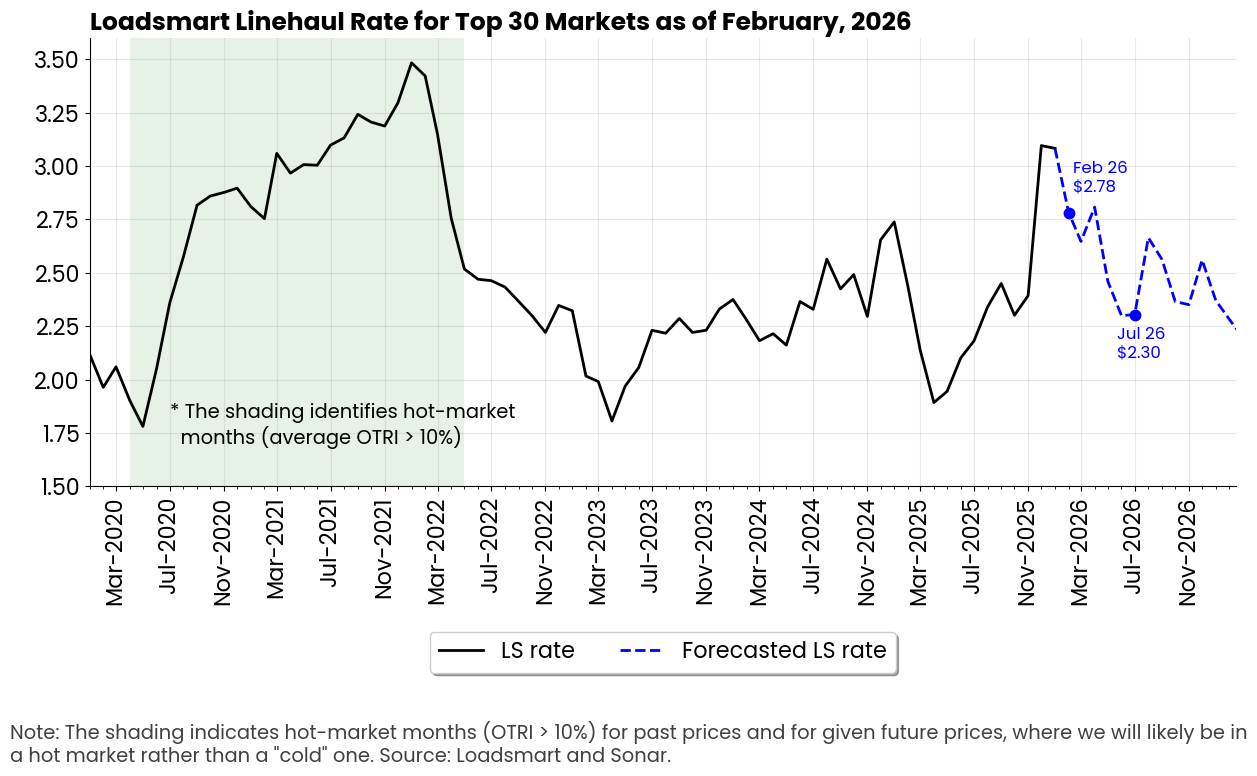
Loadsmart’s Top 30 Spot Rate Forecast
Our DRV spot rates fell just 0.4% MoM, much softer than our projected 16.4% decline. We now forecast a more gradual adjustment, with rates expected to decline 4.6% MoM in March 2026.
As usual, December and January rates climbed due to tightening capacity, but the magnitude of the increase and current rate levels prompt an important question:
Why were dry van spot rates in January 2026 12.5% higher than in January 2025?
Freight volumes were not stronger this holiday season. Both SONAR and DAT showed that holiday volumes were below prior-year levels. This is partially because the holidays were pulled forward into late 2025, reducing demand in parts of December and January. This indicates that the large increase was not demand-driven.
The difference was supply. Severe winter storms reduced truck availability, while continued carrier exits made capacity tighter. Together, these factors amplified spot rate pressure during the holiday season.
Why didn’t the market unwind cleanly after January as we previously predicted?
Winter Storm Fern disrupted core freight corridors at the end of January and into early February. In regions like the Northeast and Midwest, spot rates climbed another $0.50 per mile from January to February.
The storm (Jan 23–27, 2026) moved from the Southern Plains through the Midwest and into the Northeast, pushing rejection rates higher and tightening effective trucking capacity in key hubs such as Chicago and across Ohio during the first two weeks of February.