Share this
You Are Scoring the Wrong Thing
If you run transportation for a large shipper and you are in the middle of a TMS selection, there is a good chance the scorecard in front of you measures the past.
First, who this is not for. If you are a small or mid-sized shipper moving freight on spreadsheets, email and phone calls, buy a modern TMS. Almost any good one will pay for itself in the first year.
If you are on a legacy platform that has spent the last decade inside a private equity portfolio with close to zero R&D behind it, you should also move. That software gets older every quarter, and nobody is coming to fix it.
This piece is for a different reader: the VP of supply chain or director of transportation who already has a TMS, is frustrated with parts of it, and is thinking about a replacement. Maybe the RFP is already out. There is a spreadsheet with 200 functional requirements, five vendors booked for demos, and a scoring model weighted on screens, workflows and integrations.
My argument is simple. That RFP answers a question that matters less every month. Within one to two years, most of the work your team does inside a TMS will be done by AI agents.
The decision in front of you is how your logistics department will operate when that happens, and which platform choices get you there safely. Picking the system your planners click through all day is a smaller part of that decision than the RFP suggests.
Twenty Years of Clicking
For two decades, adopting a TMS meant the same thing. You bought the system, then trained a team to operate it. Planners and coordinators live inside the software all day. They key in orders, tender loads, chase carriers for status, upload BOLs and PODs, reschedule dock appointments, check invoices, and push every shipment from one status to the next. The TMS holds the record. People do the work.
On the autonomy ladder I like to borrow from self-driving cars, most enterprise freight operations sit at level 1 or 2. Software records and organizes, and it assists with a few specific tasks like rate recommendations or ETA alerts. Humans still execute almost everything.
That is changing fast. AI agents can now handle a large share of this task work: tendering and retendering, tracking, document collection, appointment scheduling, load audits, claims.
Within one to two years, more than half of the clicks inside a sophisticated shipper's TMS will be made by AI agents. That is more aggressive than most analysts expect. I think the timeline is shorter because the work in question is repetitive, rule-based and high-volume, which is exactly where agents already perform well. Some companies are there today.
The TMS will remain your system of record. The time your team spends inside it will collapse. So the real decision is how you move your logistics department up the ladder, to a model where your people write the rules and handle exceptions while agents do the execution.
And that raises the practical question: how do you deploy agents safely, across every system they need to touch?
The Trade-Offs of Agents Inside the TMS
Every TMS vendor now has an agent story. Before you evaluate one in an RFP, separate two things: what is on the slide, and what is running in production.
Start with the marketing. The largest ERP-anchored suites announce new agents at every conference. Ask them for three reference customers with an agent running live transportation workflows inside their TMS today. This year we spoke with dozens of enterprise shippers. Almost none had an agent working in production, and most did not know agents for transportation existed. A lot of what you see is roadmap or vision. Gartner has a name for the broader pattern, "agent washing": rebranding chatbots, assistants and RPA as agents. It estimates only about 130 of the thousands of vendors claiming agentic AI are real, and that more than 40% of agentic AI projects will be cancelled by the end of 2027.
Then look at the ones that work. Some TMS-embedded agents do deliver. They can tender, track and update statuses well. Their limit is structural: they only see what the TMS sees.
Freight problems rarely stay inside one system. Take a truck running three hours late. An agent inside the TMS can update the ETA and send an alert. It cannot see that the dock door it was booked into now belongs to another load, that the yard is near capacity, that the warehouse built its labor plan around that inbound, or that the carrier is about to start a detention clock. Today a coordinator resolves that by jumping across four systems and a phone. An agent confined to the TMS leaves that coordinator exactly where they were.
There is a second cost. If your agents, rules and exception logic live inside one vendor's TMS, they belong to that vendor. Replace the TMS in five years and you rebuild your automation from zero.
Buy the TMS and the Orchestration Layer as One Decision
If you are unhappy with your current TMS, replacing it is a valid call. Just make the decision with the next five years in view, which means evaluating two things together: the system of record, and the agentic orchestration layer that will do most of the work on top of it.
What you should look for:
- Cross-system reach. Agents that act across your TMS, YMS, WMS, carrier portals and inboxes, regardless of who built each system.
- Works with what you have and what comes next. The orchestration layer should run on your current TMS today and keep running on whatever TMS you adopt later. Your automation should outlive any single system.
- Humans in charge. Your team writes the rules, monitors the agents, and handles the exceptions. Every agent action is logged and auditable.
- A safe path in. Start with one workflow, prove it in a quarter, then expand. Nobody should ask you to rebuild your operation at once.
This is how we built Loadsmart. We offer systems of record: ShipperGuide as the AI-native TMS and OpenDock for dock scheduling, yard and gate. On top of them sits Loadsmart AI, an orchestration layer with agents working across planning and procurement, execution, gate, yard and dock, and settlement. Those agents work with our systems and with everyone else's TMS, YMS and WMS.
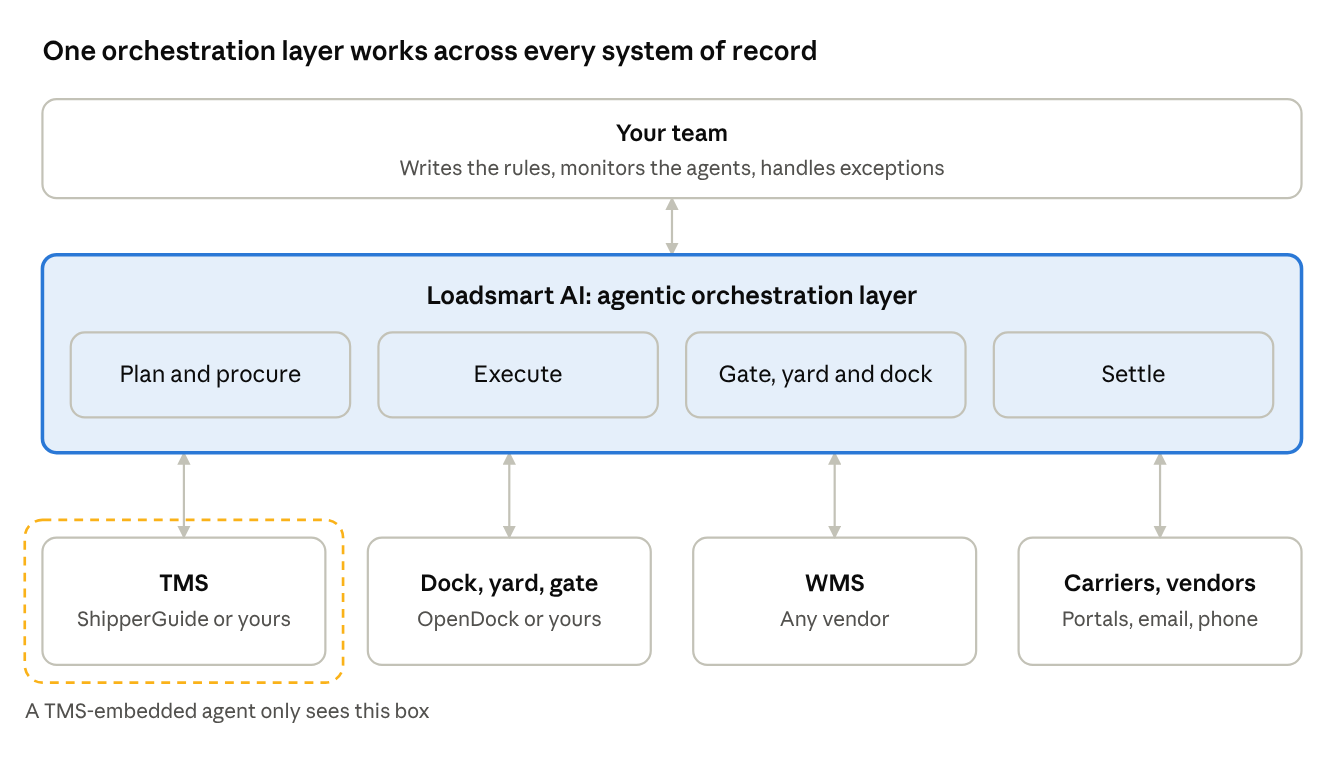
Agents in the orchestration layer read from and act on every system below them. Your team sets the rules from above.
So if you are going to replace your TMS, our pitch is direct: buy one that comes with a YMS and a cross-system orchestration layer built in. And if you are not ready to replace it, start with the orchestration layer on the TMS you already run. Either way, UX and feature depth drop down the scorecard. The question that moves to the top is how far the platform takes your team up the ladder.